Fluid Simulation with the Lattice Boltzmann Method
A SIGGRAPH 2026 course on the fundamentals and recent advances of the Lattice Boltzmann Method for fluid simulation in graphics.
Abstract
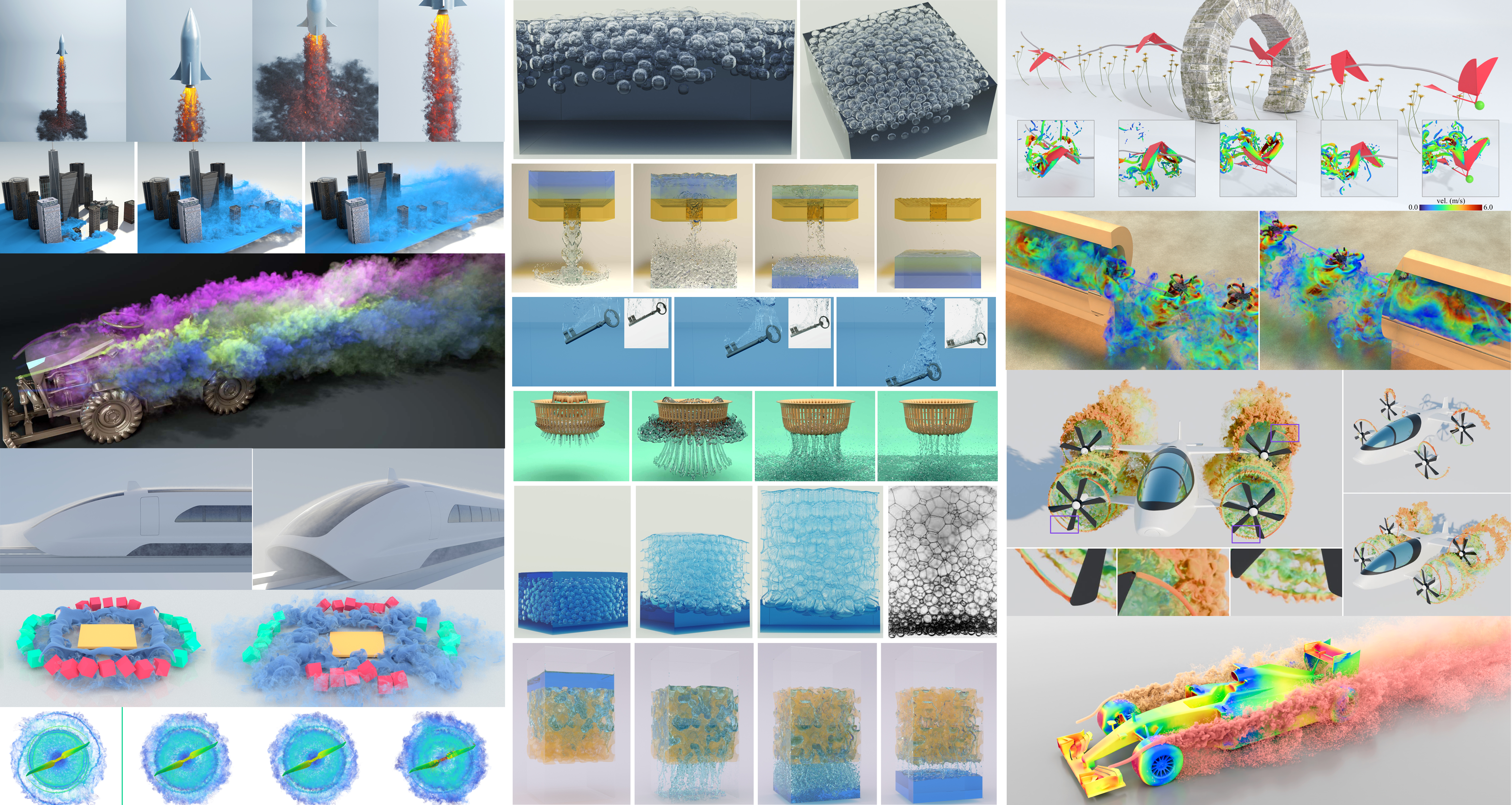
Macroscopic fluid flow solvers based on the incompressible Navier–Stokes equations are widely used in graphics, but achieving high visual fidelity in complex scenarios—such as free-surface motion, high–Reynolds-number flows, multiphase flow effects, and interactions with moving boundaries—often requires significant additional modeling and engineering effort.
The kinetic Lattice Boltzmann Method (LBM) has recently emerged as an attractive alternative for fluid flow simulation in this setting. Rather than directly discretizing macroscopic flow equations, LBM evolves mesoscopic particle distribution functions on a regular Cartesian lattice through simple, local collision and streaming operations. This decentralized structure provides excellent data locality, maps naturally to modern GPU architectures, and enables stable, efficient time integration in practice.
In these course notes, we introduce the fundamentals of the Lattice Boltzmann Method along with various recent advances that have fostered its use across a range of applications relevant to graphics and simulation, including single- and multiphase flows, fluid–solid interaction, and learning-based control for aerial and underwater robotics. We further discuss how LBM is used beyond academic research, highlighting its adoption in industrial simulation tools and game production pipelines, as well as high-fidelity visual effects.
| Type | Course |
|---|---|
| Publication | SIGGRAPH 2026 Courses |
Authors
- Wei Li, Shanghai Jiao Tong University, China
- Chaoyang Lyu, Shanghai Artificial Intelligence Lab, China
- Mengyun Liu, ShanghaiTech University, China
- Yixin Chen, University of Toronto, Canada
- Mathieu Desbrun, Inria - Ecole Polytechnique, France
- Kui Wu, Lightspeed, USA
- Xiaopei Liu, ShanghaiTech University, China
Presenters
Wei Li — Shanghai Jiao Tong University — 1104720604wei@gmail.com
Wei Li is a tenure-track Associate Professor at the John Hopcroft Center for Computer Science, School of Computer Science and Engineering, Shanghai Jiao Tong University. Before joining SJTU, he served as a Senior Research Scientist at Tencent’s Lightspeed Studio (Shanghai). Before that, he conducted postdoctoral research at Inria Saclay (France) after earning his Ph.D. from the School of Information Science and Technology at ShanghaiTech University. Wei Li’s research focuses on computer graphics, physical simulation, and physics-based deep learning. His specific research areas include high-performance Lattice Boltzmann Methods (LBM), modeling and simulation of complex physical phenomena, visualization, and high-performance physics simulation engines.
Chaoyang Lyu — Shanghai Artificial Intelligence Lab — lyuchaoyang@outlook.com
Chaoyang Lyu is a Postdoctoral Researcher at Shanghai Artificial Intelligence Lab. His research interests are physics-based simulation, computer graphics, and embodied artificial intelligence. He received his Ph.D. in Computer Science from ShanghaiTech University in 2024, working on high-performance mesoscopic methods for fluid simulation with complex fluid-solid coupling.
Mengyun Liu — ShanghaiTech University — liumy.melia@gmail.com
Mengyun Liu is a Ph.D. candidate in Computer Science at ShanghaiTech University, where she also earned her B.E. degree in 2022. Advised by Professor Xiaopei Liu, her research focuses on high-performance and high-precision fluid dynamics simulations using mesoscopic formulations, with applications in industrial design, robotics, and computer animation.
Yixin Chen — University of Toronto — yixinc.chen@mail.utoronto.ca
Yixin Chen is a PhD candidate in Computer Science at the University of Toronto, advised by Professor David I.W. Levin. Her research focuses on high-performance and differentiable fluid simulation and control, combining insights from numerical methods, physics, and computer graphics. Prior to her PhD, Yixin received a B.Eng. in Computer Science and Technology from ShanghaiTech University.
Mathieu Desbrun — INRIA / Ecole Polytechnique — mathieu.desbrun@inria.fr
Mathieu Desbrun is an advanced researcher at Inria Saclay and a Professor at Ecole Polytechnique, where he focuses on geometry-driven numerics, covering data analysis, machine learning, and simulation. Earlier, he was a faculty member at Caltech (USA) in the Computing and Mathematical Sciences department for over twenty years. He was named an ACM Fellow in 2020, and became a SIGGRAPH Academy member in 2021. He has organized a number of courses at SIGGRAPH over the years, including Discrete Differential Geometry, Geometry Processing with Discrete Exterior Calculus, and Vector Field Processing on Triangle Meshes.
Kui Wu — LIGHTSPEED — kwwu@lightspeed-studios.com
Kui Wu is a principal research scientist at LIGHTSPEED studios. Previously, he was a postdoctoral associate in the Computational Design and Fabrication Group of Prof. Wojciech Matusik at MIT CSAIL. He received his PhD degree in Computer Science from the University of Utah in 2019. His research interests are computer graphics, including modeling, rendering, simulation, and fabrication.
Xiaopei Liu — ShanghaiTech University — liuxp@shanghaitech.edu.cn
Xiaopei Liu is a tenured Associate Professor at the School of Information Science and Technology (SIST) at ShanghaiTech University. He obtained his Ph.D. in Computer Science and Engineering from the Chinese University of Hong Kong (CUHK) and conducted postdoctoral research at Nanyang Technological University (NTU), Singapore. His work focuses on high-performance simulation and visualization for classical and quantum fluids using mesoscopic approaches, and extending to fluid-interactive robotic simulation, control, and learning. These contributions have been applied to the verification and optimization of aircraft and automotive design, sim-to-real robotic systems, medical diagnosis, visual effects, and fundamental scientific research.